
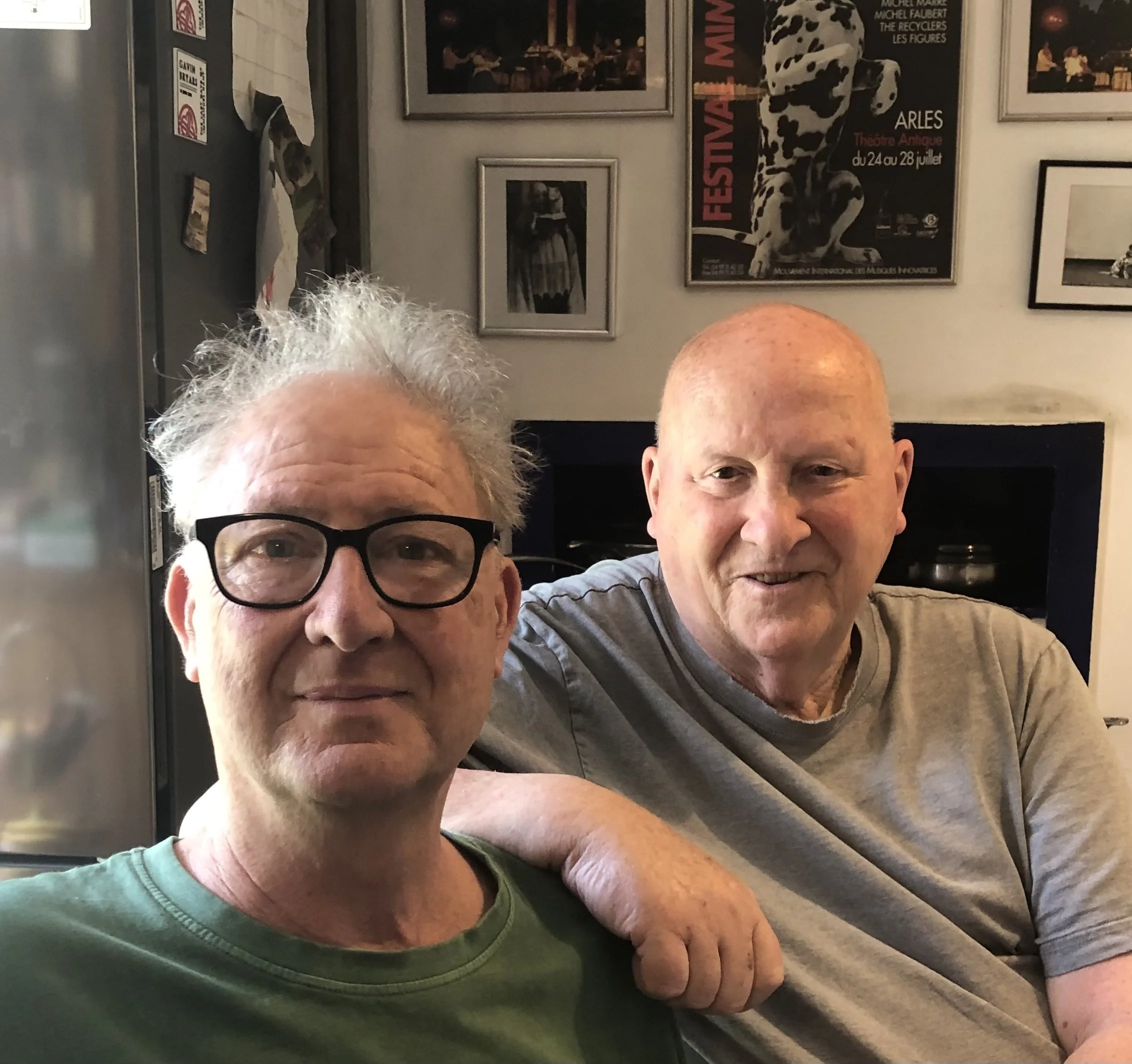
Composer Gavin Bryars and ‘Feldman in Love’ author Stephen Chance in conversation at Gavin’s Leicestershire cottage on 26 May 2026. Part 1: Steve was keen to hear more about Gavin’s interactions with Morton Feldman and John Cage.
SC: What about you and Feldman?
GB: Eventually I did finish the work with Cage and, when I was in New York, I went to see Feldman in Lexington Avenue.
SC: Above the dry cleaners? Was that where he was then?
GB: Yeah, he was over the top of a Chinese laundry. I called in to see Feldman again and I happened to have a bit of a financial problem. My aunt had given me this ticket, in January, and it had an open return. But when I came back, the actual flights were during the summer, but that wasn't covered by this open return so I had to pay one hundred dollars difference. My brother was going to try and send some over to me from England.
SC: Right.
GB: In the meantime, I'd gone around to see Feldman because he asked me to come round and see him when I came back, so he could find out what John was up to and so on. His new stuff.
SC: Right. To keep tabs on what Cage was doing?
GB: Yeah. And I explained this money problem, and Feldman offered to give me the one hundred dollars.
SC: That's amazing.
GB: Just like that. Just as Cage was very generous, Feldman did the same. As it happened, my brother managed to pay directly. But the fact that he did that was remarkable.
SC: Was the first time you met Feldman arranged by Cage?
GB: I really don't know how I got his contact address or phone number.
SC: There'd be people like Wolff and Earle Brown or Tudor?
GB: I wasn't in touch with any of them. No. I got to know them later. I had their work, but I didn't know them personally.
SC: I think the first time that I met you, I don't know whether you remember, but I met you because our bookkeeper's husband Andy was involved with you in a jazz club in Sheffield. I'd been talking to them and they put me in contact with you, and I met you at the Union Chapel, in the bar. Later, when you came round to our house you did this great impression of Feldman, which was a kind of broad Brooklyn accent, you know, ‘don't put dat dere’ kind of thing. I can't do it in Brooklynese. And I was wondering, because I keep reading that Feldman was, you know, loud, bombastic, brash, arrogant and all of that in contrast to his music. It's one of the things that attracted me to the story. How did you find him? Did you find him like any of those things?
GB: No. I mean, I found he could be like that in company if he's involved in a sort of music theoretical situation, like some sort of seminar or a meeting. And he's offering his opinion. He could be like quite aggressive and dominate and he could be quite bullish. But one to one? Not at all. He listened to what I was saying and when he spoke, he still had the accent, but it was just low key. And he was actually a thoroughly nice guy. I only met him like that in his flat, those two times. I met him a few times later.
SC: You didn't meet him in the bar?
GB: No.
SC: I guess that would be different again, as I surmise in my novel. Did he show you what he was working on?
GB: He did. In fact, he did a little bit of work while I was having a cup of coffee. He was working on a piece called in In Search of an Orchestration and the manuscript's on the piano. He would sit at the piano with the pencil, screw up his eyes and look at the notation. Then look down at the keyboard. He'd put his hands out and eventually play something. Then he'd write it down. Then he'd stop and go to another one. And again, but not really relating at all to what he just played. There were just all these little isolated sonorities. It was all entirely physical. This sounds good, and this doesn't sound like the last one. I was impressed - the walls were full of paintings, you know, and all from friends like Philip Guston and Rothko. A whole bunch of people.
SC: He had a Pollock sketch. Probably other things.
GB: You know, de Kooning. It was all that school. From the early fifties, through the fifties.
SC: They were his mates, weren't they?
GB: They were. Absolutely. And there were really substantial big paintings on the walls. Not just little things. It really made a statement.
SC: And you didn't meet his wife or anybody else there? Just Feldman?
GB: Well, he was on his own. I met him again later, of course, when he came to the UK. I’d meet Cage when he was overseas, for example, the performances organised around various birthdays, like his sixtieth birthday in 1972. At the time I played quite a lot of Cage's work and it reminds me that there's this photo of me in a newspaper in 1969 when I was living in this little flat in Kilburn. I've got all these transparencies and things and these toy cars and I'm unscrewing things and putting them together. There’s a photo and it was Page 3 of The Sun!
SC: I hope you kept your shirt on!
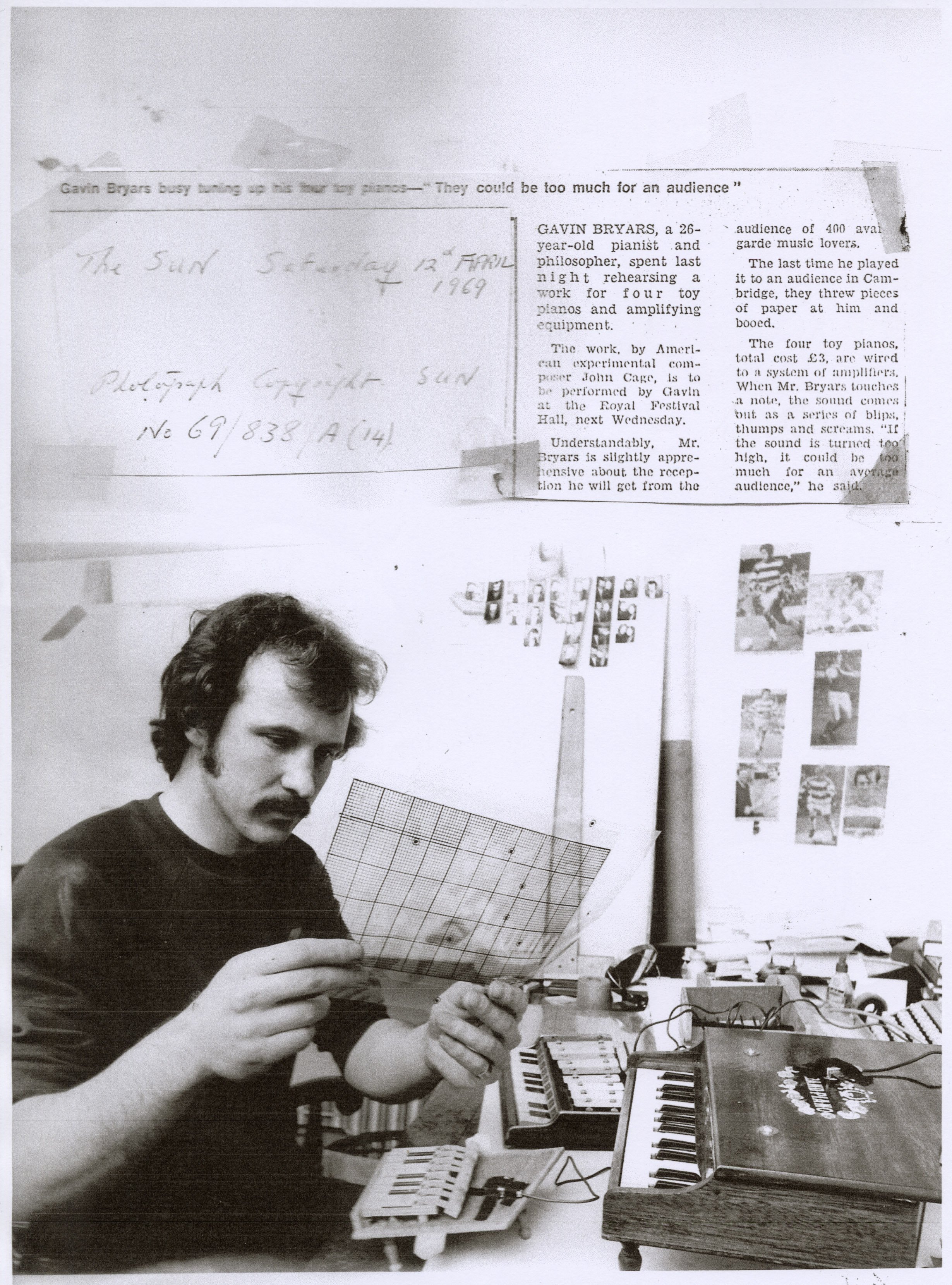
The Sun Page 3: 12 April 1969. Gavin with his top kept on.
GB: It was, you know, “philosopher Gavin Bryars, 26, says of all these things around him, it could be too much for an audience”. I was probably responsible for the editorial change where the owner would turn around and say, “look, mate, on Page 3 a philosopher talking? Get some naked women on there!” So, indirectly, I could well have been responsible for The Sun's change of direction.
SC: Ha ha, it would have boosted their sales dramatically.
GB: Absolutely. You can imagine the editor saying “we're losing money on this philosopher shit you've got on Page 3 at the moment – get some tits on there!”.
SC: Getting back to Feldman, would you say that in your music - you obviously had some inspiration or influence from the way Cage approached things - but what you were saying with Feldman, he's basically, not improvising exactly, but trying it out on the keyboard until that chord sounded right and then seeing what the next one felt like next to that one? Did that influence the way you approach things?
GB: No. I never did that. But what I did learn from the kind of harmonies that he put there was he could write something that was extremely dissonant, but because he played it at such a low volume, it wasn't dissonant. It became a rather spiced consonance.
SC: Absolutely.
GB: I enjoyed the idea of putting dissonance, but instead of doing it aggressively, you would do it very quietly. Then it has a sort of resonance, which is not a simple thing, but it's an attractive thing.
SC: It’s fascinating, because nearly all of his chords are just semitones. You know, C, C#, D, D# but maybe spread out over the keyboard or maybe played in an inversion or something. And the high grace note and all of that. So he generally avoids any conventional chords, even a complex chord like a minor 9th flattened 5th or something.
GB: No, I don’t think he would ever even put his hands round a triad. Not a chance. And if a triad came, he wouldn’t use it. I don't think there's ever in any Feldman that kind of sound at all. Whereas with Cage, if that turned up by chance, he'd accept it. He wouldn't necessarily like it. But then, of course, liking it is not the point, is it?
SC: Not really. You've got to accept whatever your chance mechanism throws up as the answer. Which I think Feldman didn't do. Obviously, he was very influenced by the painters. I've read a few musicological books about Feldman's work, and they'll analyse the structure - where does the piece fall into three parts? Where do the repetitions vary rather than repeat? All of that… But ultimately, it's a bit like getting an abstract expressionist painting and saying, ‘well, in the top left there's a blue and next to that, a slight pink’. And you could go over the whole painting like that and it wouldn't explain anything about how the piece looks and feels, would it? And I think that's why some of his music escapes analysis of that kind.
GB: That kind of formal analysis doesn't work, as you say. Any abstract painter, you can say, ‘well, he adds this shape there for that reason’, and so on. But I always remember that that line of Barnett Newman: ‘aesthetics for an artist is like ornithology for the birds.’ If a bird starts to wonder, how do I fly? He falls to the ground. He just does it. And similarly with the instinctive painters. If you try and say, why is that blue next to that pink? But the instinctive action, that's everything with those kinds of painters.
SC: You interviewed Feldman in ‘76 and you were asking him, “have you seen any of the painters?” And he says, about Philip Guston: “Oh, things kind of cooled there.” I was reading that recently thinking, wow, that's quite an understatement, for what happened between them.
GB: Yeah. I didn't know you were going into it, but it was in an issue of Studio International. Was it November 1976? It was art and music and became art and experimental music. I did an article on three artists talking about the thing that they did other than what they are best known for. One on Duchamp’s music. In the case of Erik Satie talking about his drawings. In the case of Le Douanier Rousseau, about his musical compositions.
SC: I didn’t know about that.
GB: And also his plays. Three plays. I did the interview with Fred Orton, an artist I worked with at Leicester. He and I did an interview with Tom Phillips and another one with Feldman. Fred and I had worked on some things related to Feldman.
SC: Obviously you were quite familiar with his pieces when you're asking him about The King of Denmark, for example, and things like that.
GB: Well, when I was teaching in Portsmouth, I got hold of Denmark as a solo piece. I got half a dozen students to share the parts so they could they could actually put the thing together. These art students didn't really read music, and the notation isn't a conventional musical notation. It meant that we could work out how to do it more or less, you know?
SC: Yes. Another thing I spotted in that interview was, again talking about Guston, where Feldman says, “boy, was he demanding!” Obviously he worked hard at that friendship with Guston. And Guston had moved away, moved away from him gradually and in a sense Feldman never made a radical change of style in the way Guston did. He sort of stuck to what he felt was right. And he got a lot of damning reviews. He must have had an inner strength to continue that painstaking work.
GB: He was really single minded. He pursued his path. I mean, when he moved into things like Rothko Chapel, where there's much more of a kind of musical flow, some people felt that he’d somehow backtracked on the earlier sort of isolated pieces. I didn't think that. I mean, I could see a reason why he'd done that. And it made sense. Rather than superimpose an old way of making music on a new project, to think how you do that. But you have your experience of that in the background, and then you do work in a different way, but it's clearly the same composer.
SC: Because that's a piece for a building, isn't it? That interests me because he also says in your interview that a lot of architects were influenced by his work, but I've rarely known any architects who've even heard of Feldman. Whereas a painter like, say, James Hugonin, has obviously been very inspired by or influenced by his thinking about Feldman. But not in architecture. Feldman was commissioned to write that piece for the building, the Rothko Chapel, and I was wondering about that because when I first met you, you gave me a copy of A Listening Room. I don't know how you’d describe it, but you composed pieces for the different rooms in a chateau?
GB: The specific spaces and the acoustic characteristics. Not just the shape, and not necessarily what was in them, but to do with the actual physical nature of each room.
SC: And then what happened? There was a room where you listened to all the pieces from the different parts of the chateau?
GB: Yes, we recorded in about nine different spaces. And we recorded them with a special microphone which you can programme in different ways. And we programmed it so that the recording would be what's called ambisonic. Like there’s eight microphones in there, but they're getting a perfect three hundred and sixty degrees. It sort of reproduces exactly the character of the environment in which you've recorded. I remember the BBC, for a time, did some experiments with ‘dummy head’ recordings for Radio 4 plays. Oe was a Sherlock Holmes story, and when you listen to it it's like a very nice stereo, but you put the headphones on and when Holmes speaks to Watson and Mrs. Hudson comes in and asks ‘do you want a cup of tea?’ she comes from behind you like this, right? And ambisonics has that characteristic to it. So we a had a room in the castle which is the listening room where this was set up and it's still there. It's now in what was the former kitchen. I've been back a couple of times and you can listen to it just as we did it in 1992/93.
SC: So you're in one room and you're listening to the sonic experience of that performance in a different room, in a different part of the chateau.
GB: I thought it was like a kind of a sort of an acoustic map of the castle. I mean, if I'd done every room, that was what it would be. But I took rooms which had very different characteristics. There's one very beautiful circular one in one of the towers and another one which is like, I think it's one of the longest sort of Renaissance galleries. Really, really long. And that had, of course, very different characteristics.
SC: Plus, you had the village band marching up towards the chateau.
GB: At the beginning. We had members of the village band playing other things, too.
SC: You hear them arriving, don't you?
GB: They come into the chateau and they're playing their march. The village is next door to this enormous chateau and the village is about a hundred people, and they have this little band that meets every Friday night, you know. It was a kind of way of dealing with the architecture.
SC: Feldman's task was different because he had to compose a piece for that chapel space. That piece is probably one of his best-known pieces and gets performed in all kinds of spaces.
GB: Well, it's for an ensemble and it's like a real piece of music in that it has movement in time. So you could inject it into a concert of chamber music. It can move into that other world, the conventional world.
SC: Are you in touch with John Tilbury at all?
GB: Yes, I went to see him because he stopped playing altogether. He was ninety in February. He lives in Deal, on the coast. I went down one day and I mean to go back because there was a project he had with a record company and they sort of let him down. They were putting together a box set of his work. But in parallel, they had this recording of John playing John White's sonatas, and they were going to bring that out separately alongside it. And they they didn't. But I've got the masters and I'm going to bring it out myself. So I mean to go down to see John, but it's a day out and quite often I come back from touring and for a couple of days I’m recovering from travelling and have to get on with some other work. John and I became very close when I came back from America. We worked together on a lot of stuff.
SC: I put this little bit at the end of my book, an afterword, that I went to Huddersfield and Tilbury was playing For Philip Guston there and he said that Feldman himself quite often played so quietly that some of the notes didn't sound. And John said to Feldman, ‘Why don’t you just play it again straight away? You know, just play the chord again in that spot. And Feldman had said, ‘yeah, I might try, I might try that’. But John has played jazz, hasn't he?
GB: Not jazz, it’s improvised. But John is a beautiful player. I mean, he was always, I think, the best Feldman player. The best one I ever heard. He has a beautiful touch.
SC: Gavin, I have to say that I really appreciated you helping me with your feedback on my book. Not least because when you're writing, and you're on your own and you're slogging away, it's great to get someone saying, ‘oh, you're on the right track’.
GB: Absolutely. When I was reading it, because you put all those bits where these are known stories about, you know, Feldman and Cage in certain situations, in the house where they were living, all that kind of thing, they appear naturally as part of the flow. And they're stitched together by other things which are imaginary, though based on likely facts, you know?
SC: Absolutely. Yeah.
GB: Ultimately it has to become a work of imagination. But it starts from evidence. And then you move it more and more away. And in a way, as you're doing that, you're getting more and more inside the minds of the people concerned. And then, it becomes a living story. I think it's terrific.
SC: Thank you!
SC: By the way, how are we doing for time? You’ve got things to do.
GB: I know my son's on his way back. He went down to London. We’ve got a bit more time. Would you like a cup of coffee?
SC: Yeah. Great.